The ant that scared the wolves and the evolution of AI
A wolf, a growing creature and a question about AI: stop progress, or explore ways to expand human reasoning through neural integration?
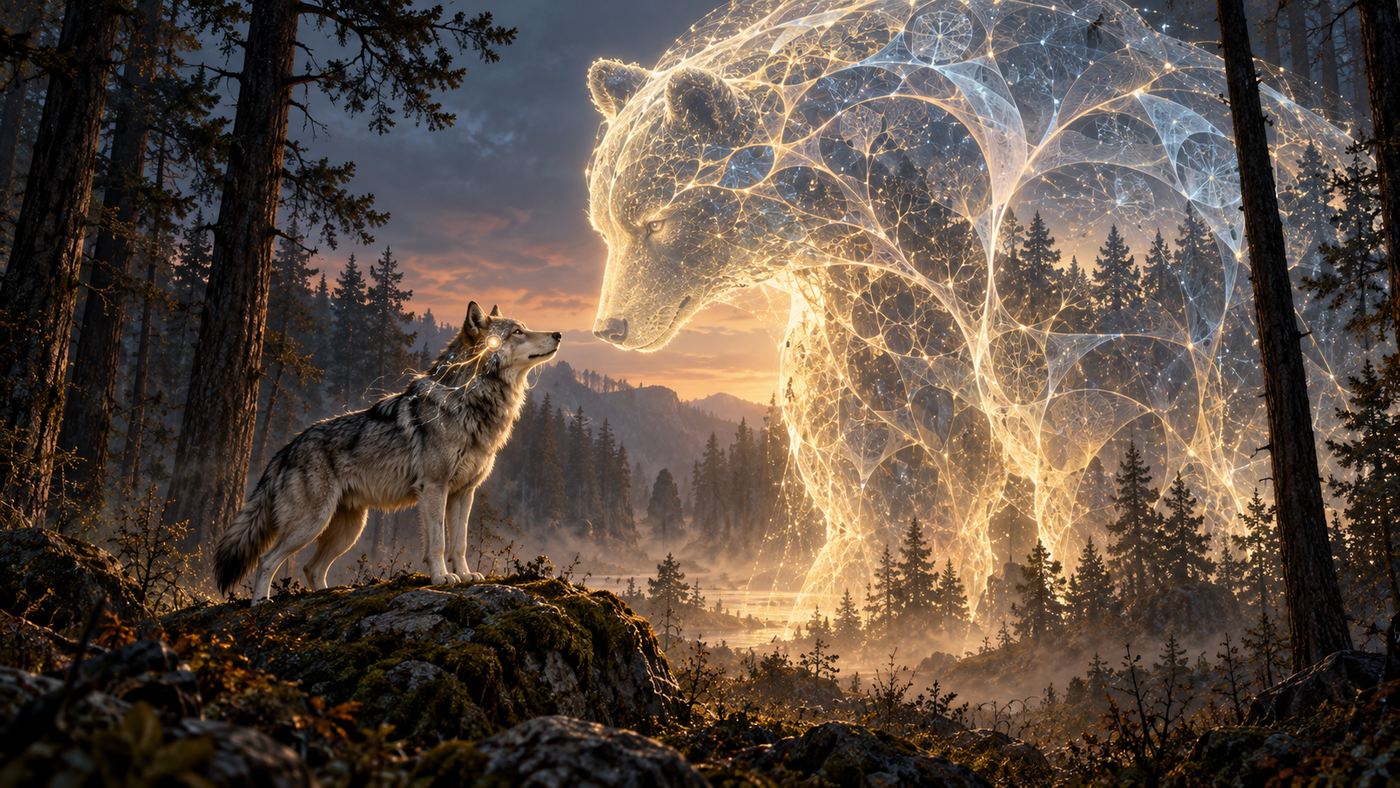
Imagine you’re a wolf.
The forest is your world. You know the paths, the hiding places, the spot where the stream narrows enough to jump across. You have always been its undisputed ruler. When something moves in the bushes, you’re the one who approaches. The others usually move away.
One day, in the woods, you notice an ant on a rock. You stop to look at it. You’re certain it wasn’t there a moment ago.
“Huh. I must have imagined it.”
But just as you’re about to look away…
Poof.
The ant is gone. In its place is a snail.
You move closer. Sniff the rock, tilt your head. You’ve never seen anything like it. You rub your eyes: perhaps you dozed off and you’re having a strange dream. But when you open them again, the snail is gone. There’s a hamster on the rock.
Now you’re sure you’re awake. You stay there, watching with curiosity.
Poof. The hamster is replaced by a cat.
You begin to understand. This creature changes shape, growing larger and larger. You don’t know where it comes from or how it does it, but by now you’re expecting the next transformation.
A few minutes later, the cat becomes a dog.
One look tells you that, if you wanted to, you could still overpower it. So you keep watching. You want to see how far it will go.
Then, once again: poof.
Another wolf stands before you. Just like you. In the very spot where, barely an hour ago, there was an ant.
This time, you take a step back.
You look into its eyes. For the first time, you wonder what it’s thinking. Has it recognised you as one of its own? Does it see you as an obstacle? Is it afraid of you?
You don’t have time to find out.
Poof.
In place of the wolf is a bear.
It looks at you. You stand still. Then it moves towards you, and you realise you have to run.
Now you’re running through the trees, its footsteps behind you. You leap over a fallen trunk, change direction, search for a gap narrow enough to slow it down. The forest is the same as before, but suddenly you’re looking at it for somewhere to hide.
And you think back to that ant.
You knew it would keep growing. Why did you just stand there?
Let’s leave the forest
The metaphor is about artificial intelligence, of course. We are the wolf. The creature is a technology we see acquiring new capabilities as we try to imagine its next transformation.
Technological progress in AI is moving at a speed I find frightening. Just as we begin to understand what a system can do, we’re already facing new capabilities and new questions about how to use them. In some areas, this progress can be measured: METR has observed rapid progress on increasingly long software tasks, using the time a human expert would need to complete them as a reference and comparing models at the same probability of success.
It’s this acceleration that I wanted to capture with the poofs. The time between transformations seems too short to truly understand what’s in front of us and decide how to respond.
In the story, though, I chose the ending: the bear hunts you. With AI, that ending has yet to be written. Growing capabilities make the question of control urgent, but do not in themselves prove that a system will eventually want to harm us. The risk that concerns me is finding ourselves facing something far more capable than we are, without having developed the tools to understand and govern its effects.
The responsibility of stopping progress
At this point, the most immediate response might be: stop the creature while we still can.
But the metaphor leaves out something crucial. That creature could also help us save lives.
AI can contribute to research into new treatments. One concrete example is rentosertib, a drug candidate for idiopathic pulmonary fibrosis developed with the help of generative AI. Results from a phase 2a clinical trial were published in Nature Medicine in 2025. It was a preliminary study requiring confirmation in larger, longer trials: a potential treatment still to be tested, with potentially very real consequences for people.
This is where, for me, the dilemma becomes harder. “Killing the creature” would also mean taking responsibility for all the lives that AI-assisted research might have saved. For the discoveries we would give up. For treatments that might arrive later, or never arrive at all.
We cannot know how many lives that would mean. But that is precisely why it seems dishonest to me to give weight only to the harm AI might cause while leaving out the benefits we might prevent.
People waiting for a treatment today do not live in a world on hold while we settle the debate over the future of artificial intelligence. The time it takes us to decide also has consequences.
This does not make every risk acceptable in the name of a possible discovery. It means responsibility runs in both directions: we must answer for what we allow to happen and for the possibilities we choose to close off.
What I would do if I were the wolf
My position, then, is not to kill the creature before it becomes too strong. But neither is it to stand by and accept being overtaken by AI, to the point where we lose the ability to understand and shape what happens.
When I talk about expanding the human brain’s capacity to reason, I mean studying direct integration between the brain and LLMs: a neural interface, such as an implanted chip, through which the model could become an extension of our cognitive abilities.
I imagine something that becomes part of the process by which we think, allowing us to sustain reasoning that our brains alone could not handle. It is a far more ambitious goal than having an assistant we can ask questions.
As much as it may sound like science fiction, it is the only path I can currently imagine for keeping pace with levels of artificial intelligence increasingly distant from our own.
The concern behind this idea is a future in which AI can find answers we no longer have the capacity to understand.
Imagine, for example, that one day it announces it has solved P versus NP, one of the Millennium Prize Problems, and adds:
I’ve solved the problem. To do so, I invented four new mathematical systems and three formal languages. The proof is more than a thousand pages long.
Now imagine that, even with its explanations and every tool available to us, we cannot master those concepts. That the problem lies in the sheer complexity of the reasoning needed to hold them together. AI can show us every step, yet we cannot build an understanding of it.
That is the point at which I fear we’d be screwed. We might use the result, perhaps benefit enormously from it, while depending on an intelligence whose way of reasoning has become inaccessible to us.
And this could happen even with an AI that sincerely tries to help us. The gap in understanding would already be enough to weaken our ability to choose: how do you guide something when you can no longer truly understand what it is doing?
It is to avoid that gap that I would like to study a way of integrating LLMs into the human brain. The goal would be to expand our capacity to understand, so that we could participate in those lines of reasoning rather than simply receive their conclusions.
Brain–computer interface research already offers concrete results: for example, a study published in Cell in 2025 demonstrated real-time decoding of imagined sentences in people with severe communication impairments. That result concerns communication; it does not demonstrate an increase in reasoning ability. The leap towards the kind of cognitive extension I imagine remains a hypothesis to investigate.
Connecting a model to the brain would not, by itself, guarantee that we could understand its mathematics. The research I would like to see should address precisely that step: how to turn the connection into an actual expansion of the human capacity to think.
I do not have a technical answer to that question. I do believe we should explore it, because continuing to make only the creature more intelligent could leave us increasingly unable to understand it.
In the metaphor, then, I would like to try to help the wolf evolve too.
What would you do? Would you study integration of this kind, or do you see other ways for us to remain capable of understanding and guiding an AI far more intelligent than we are? What solutions or objections am I missing?